 MacroEnergy
Tariff wars - No turning back
April 10, 2015
by Ron Hanes
Recent developments in U.S. trade policy have reignited global concerns about escalating tariff wars and their broader economic implications. On April 2, 2025, President Donald Trump announced a universal 10% tariff on all imports, with additional higher tariffs targeting specific countries. China faced an additional 34% tariff, bringing the total to 44%, while the European Union and Japan were subjected to 20% and 24% tariffs, respectively.
In response, China swiftly imposed tariffs ranging from 10% to 15% on key U.S. exports, including crude oil and liquefied natural gas, effective February 10. The European Union also signaled its intent to retaliate immediately if the U.S. proceeded with the new tariffs. The situation further intensified when, on April 8, President Trump increased tariffs on Chinese imports to 104%, citing China’s retaliatory measures. Additionally, he raised the de minimis tariffs on low-cost parcels from China and Hong Kong to 90%. The following day, Trump announced a 90-day suspension of most new tariffs but escalated tariffs on Chinese imports to 125%, emphasizing the need to address trade imbalances.
These tit-for-tat measures have led to significant market volatility. The S&P 500 experienced one of its largest gains since World War II, surging 9.5%, following the announcement of the tariff pause. However, economists and business leaders warn that the ongoing trade tensions could strain international alliances and trigger a severe recession.
These developments underscore the delicate balance of international trade relations and the potential consequences of protectionist policies. As nations navigate these turbulent waters, the principles of game theory, particularly the Nash Equilibrium, offer valuable insights into the challenges of achieving cooperative outcomes in a competitive global landscape.
Pause or Reversal Won’t Undo the Damage
Even with the 90-day pause, the deep damage has alreadybeen done.
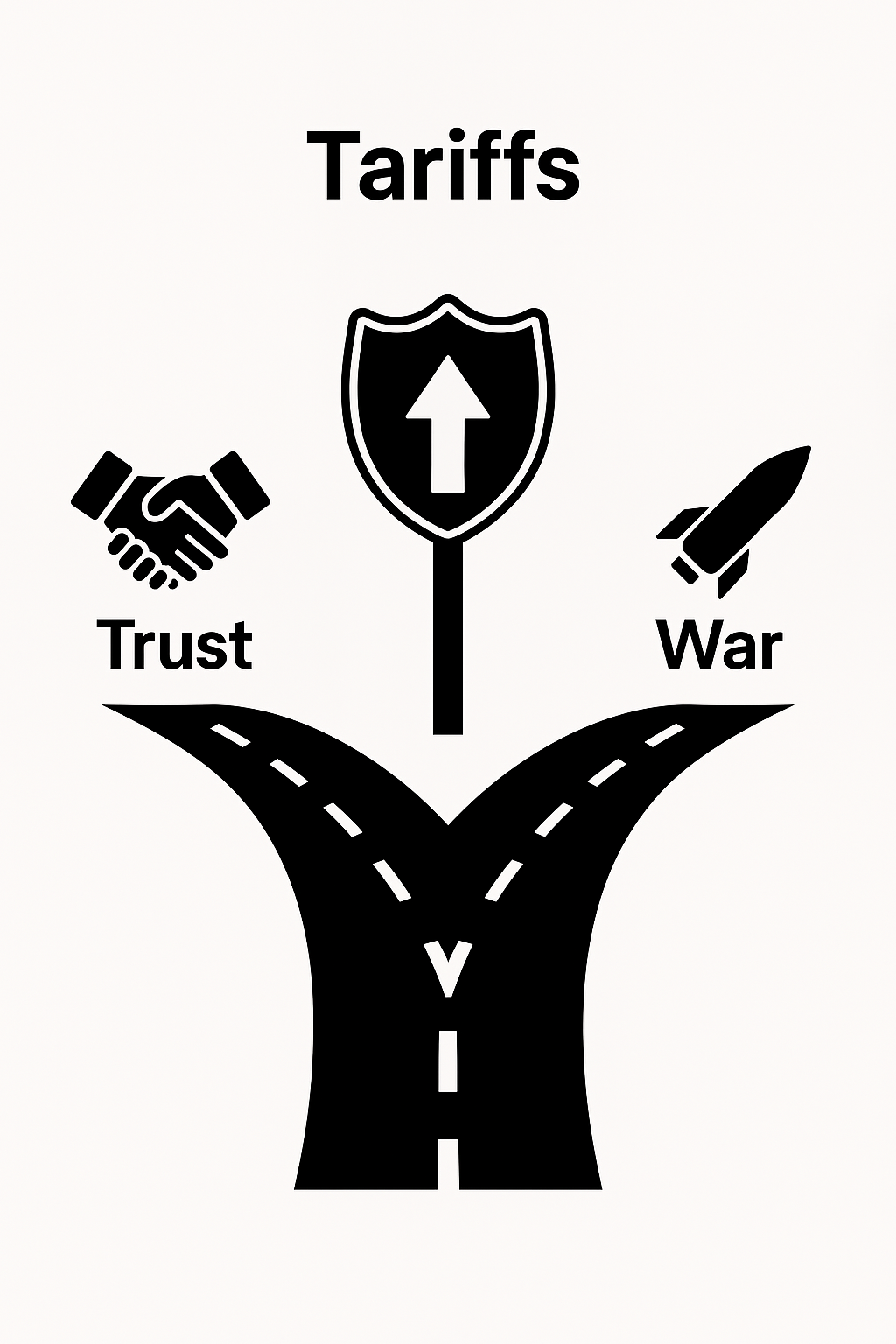
Trust is broken: Countries and companies now expectsudden trade disruptions.
Investment stalls: Firms hesitate to build factories inunstable environments.
Supply chains reroute: Companies move away from volatilepartners.
Political risk soars: Insurance costs for global traderise dramatically.
Even if leaders reverse today’s tariffs, the memory ofthis shock reshapes behavior for years.
What Is the Nash Equilibrium Again?
Quick Lesson:
The Nash Equilibrium explains how, in competitivescenarios, individuals (or countries) often end up stuck in a bad outcome—notbecause they want to, but because they’re protecting themselves.
In trade:
• If bothcountries cooperate (lower tariffs), both win.
• If one cheatswhile the other stays open, the cheater gains.
• But if bothretaliate (tariffs vs. tariffs), both lose—higher prices, slower growth,and mutual pain.
The Latest Tariff Escalation: How We Got Here
Timeline:
April 2, 2025 — Trump imposes a universal 10% tariff,with extra charges for China, the EU, and Japan.
April 4, 2025 — China retaliates with 10–15% tariffs onU.S. oil and gas.
April 8, 2025 — Trump hikes China tariffs to 104% andtargets low-cost parcels.
April 9, 2025 — Trump pauses tariffs for most countriesfor 90 days, but raises China tariffs to 125%.
Trump to critics: “Yippy critics” can “watch the stockrebound!”
Markets soared briefly—the S&P 500 jumped 9.5%, oneof its largest single-day gains since WWII. But beneath the rally, fearssimmer.
The Forecast: What’s Next?
If escalation continues: - Global growth slowsdramatically. - Supply chains fragment permanently. - Geopolitical rivalriesharden.
If cooperation returns: - A fragile recovery becomespossible. - New, binding trade agreements are needed, with clear enforcementmechanisms. - Rebuilding trust becomes the core global project.
Critical Point:
Without trust, every trade deal will be seen as temporary—andcompanies will bake in “tariff risk” forever.
Conclusion: Cooperation, Not Combat
Global trade isn’t a zero-sum game. It’s interdependence.
Protectionism sounds powerful, but ultimately it leaveseveryone poorer and more vulnerable.
The real “winning move” is escaping the Nash trap:
• Build credible institutions.
• Foster transparent negotiations.
• Lock in mutual incentives to cooperate.
Otherwise, today’s tariff war will be tomorrow’s new normal.