 MacroEnergy
Biofuels Next Act: The Feedstocks That Will Fuel 2030
The easy growth is running out
The next five years will be less about simply producing more biofuels and more about finding enough sustainable feedstock to make them.
Global liquid biofuel demand is expected to reach around 215 billion litres a year by 2030 in the IEA’s base case, with aviation and shipping accounting for more than 75% of new demand.
That changes the feedstock equation. The industry can no longer rely on simply expanding conventional crops. Vegetable oils, used cooking oil and animal fats are already being pulled into competing markets, while demand for biofuels is growing faster than many feedstock supplies.
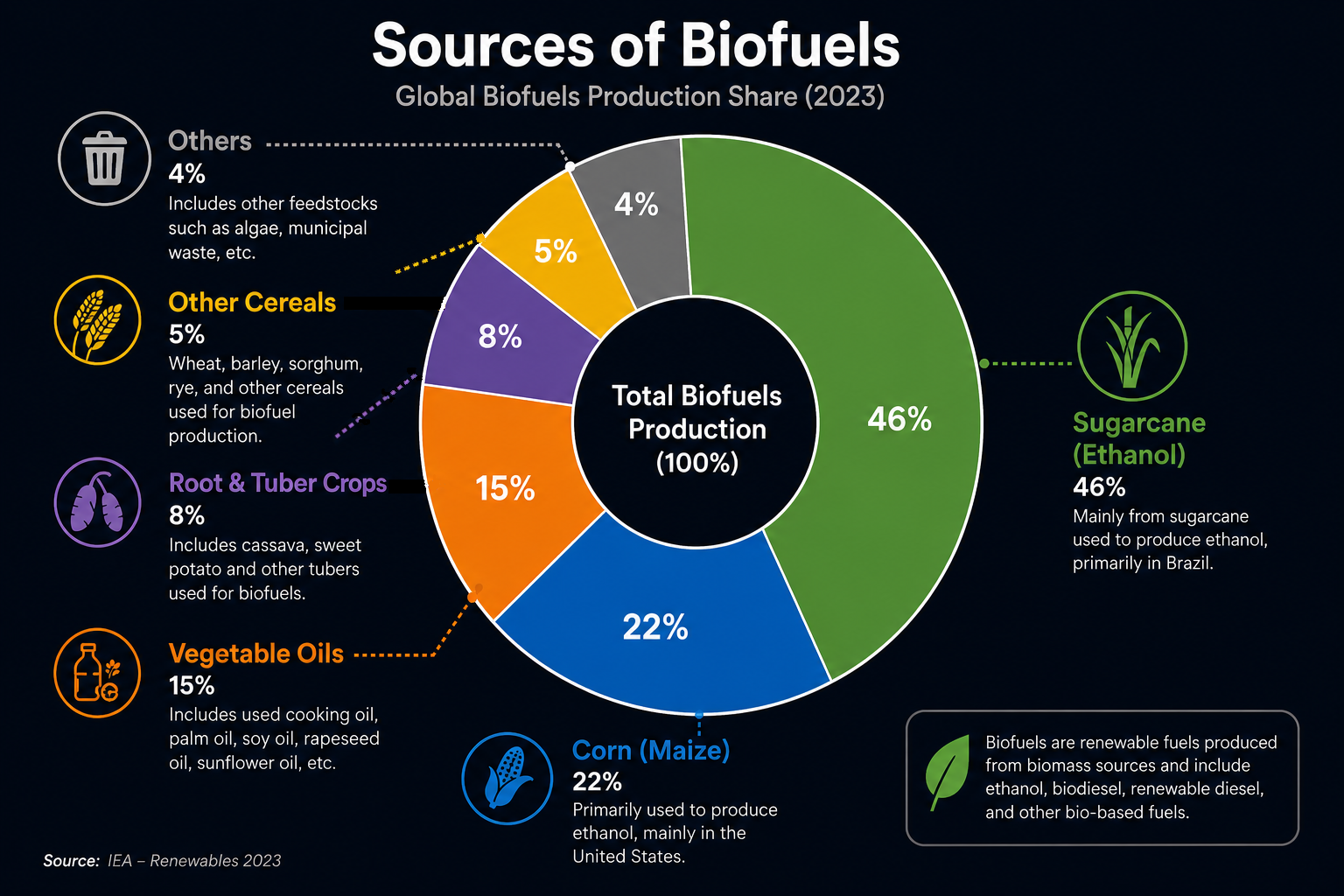
The result will be a two-speed market: conventional feedstocks will provide most of the volume through 2030, while wastes, residues and new technologies become increasingly important at the margin.
1. Corn and sugar will still do the heavy lifting
The biggest source of incremental biofuel supply will remain the most familiar: crop-based ethanol.
Corn will continue to dominate US ethanol production, while sugarcane will remain central to Brazil’s expanding ethanol market. Brazil, the US, India and other emerging markets are expected to drive much of the growth as blending mandates increase and gasoline demand remains resilient.
This is important because the biofuel story is often portrayed as rapidly moving away from food crops. That is not what the numbers suggest over the next five years.
The IEA expects demand for sugar feedstocks to increase substantially through 2030, while starch demand remains broadly stable.
Conventional ethanol therefore remains the volume engine — particularly in road transport.
2. Vegetable oils become the battleground
The more interesting story is in diesel.
Soybean, palm and rapeseed oils will supply a growing share of biodiesel and renewable diesel, particularly in Brazil, Indonesia, the US and Europe.
The IEA forecasts total biofuel feedstock demand approaching 825 million tonnes per year by 2030, roughly 25% above 2024. Vegetable-oil demand alone rises by nearly 20 million tonnes per year.
But this growth creates a problem: biofuels are increasingly competing with food, oleochemicals and other uses for the same oils.
By 2030, biofuels could account for around 27% of global vegetable-oil production, versus just under 21% in 2024.
That makes soybean oil, palm oil and rapeseed oil increasingly strategic commodities — not merely agricultural inputs.
3. Waste oils become the premium feedstock
Used cooking oil, tallow and other waste and residue oils will be among the most valuable feedstocks of the next five years.
They offer two attractions: they can deliver lower lifecycle emissions and, in many regulatory systems, receive preferential treatment.
The problem is scarcity.
The IEA expects biofuels to consume around 80% of estimated waste and residue oil supply potential by 2030, up from roughly 50% in 2024.
SAF is particularly dependent on these feedstocks. Although SAF represents only around 2% of total biofuel feedstock demand in 2030, the IEA expects waste and residue oils to provide about 55% of SAF feedstocks.
In other words, the aviation industry’s growth could put an outsized premium on the same feedstocks already coveted by renewable diesel producers.
4. SAF changes the hierarchy
The biggest structural change will be the shift in where biofuels are consumed.
Road transport will remain the largest market, but aviation and maritime fuels will absorb a disproportionate share of incremental demand.
Airlines have few scalable alternatives to liquid fuels, while shipping is beginning to face increasingly stringent emissions requirements. The IEA estimates that new maritime policies alone could create substantial additional renewable-fuel demand by 2030.
That means a tonne of feedstock is increasingly being allocated according to carbon intensity and regulatory value, rather than simply fuel economics.
SAF will therefore compete aggressively with renewable diesel for the lowest-carbon oils and wastes.
5. The next frontier: residues and biomass
The real escape valve is cellulosic and waste-based biofuels.
Agricultural residues, forestry residues, municipal waste and other non-food biomass offer a much larger theoretical resource base than vegetable oils. Technologies such as cellulosic ethanol and biomass-to-liquids/Fischer-Tropsch can convert these materials into transport fuels.
The challenge is economics.
These technologies remain considerably more expensive than conventional biofuels, and large-scale projects have struggled to achieve commercial viability without policy support.
Consequently, they are unlikely to displace corn, sugar and vegetable oils in a big way before 2030. But they will become increasingly important in the projects that are being built specifically for SAF and other hard-to-abate sectors.
The 2030 feedstock mix
The most likely outcome is therefore not a revolution but a layering of feedstocks.
Corn and sugar will continue to provide the bulk of ethanol.
Soybean, palm and rapeseed oils will expand to support biodiesel and renewable diesel.
Used cooking oil, tallow and other wastes will become increasingly valuable, particularly for SAF.
And agricultural, forestry and municipal residues will begin moving from technology demonstration into commercial production.
The critical constraint will not be demand. Policy is creating plenty of that. It will be sustainable feedstock availability.
The IEA estimates that meeting its accelerated 2030 biofuel trajectory would require an additional 125 million tonnes of feedstock, despite already tight supplies of oils, fats and wastes.
The bottom line
The next five years of biofuel growth will be built primarily on the old feedstocks — but increasingly stretched by new demand.
The winners in volume will remain corn, sugar and vegetable oils. The winners in value will increasingly be waste oils and residues. And the strategic prize will be technologies capable of unlocking the enormous pool of non-food biomass.
Biofuels are not running out of demand. They are running into a feedstock problem.
That makes the next phase of the industry less a story about how much biofuel can be produced — and more a story about who controls the molecules needed to make it.